Last verified: October 5, 2026
Independent guide. We are not affiliated with the Land Transportation Office (LTO). Fees and exam formats change — confirm on the LTMS portal or at the Driver’s Education Center before transacting.
Quick answer: To get a non-professional license: hold a student permit, complete the Practical Driving Course (PDC), pass the written exam and practical driving test at an LTO office, and pay roughly ₱685 in LTO fees plus PDC and medical costs. You must be 18+ and have a TIN.
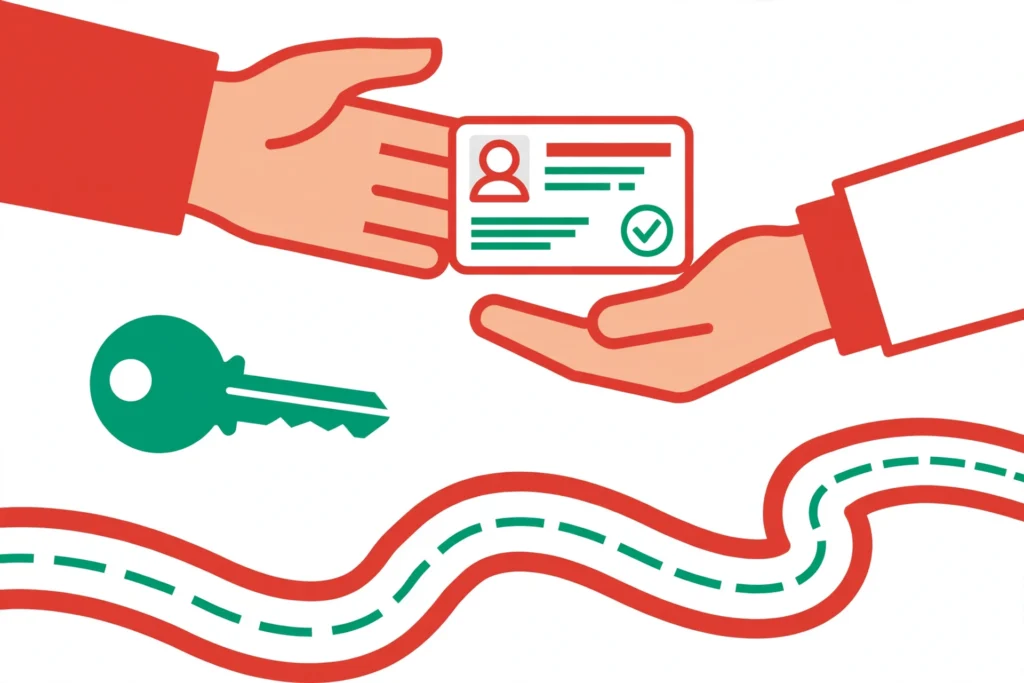
The full path: student permit → license
1. Student permit — see our student permit guide: 15-hour TDC, medical, ₱317.63 in fees, valid 1 year.
2. Practical Driving Course (PDC) — hands-on driving lessons at an LTO-accredited school for your vehicle code. Cost: ₱2,500 (motorcycle, codes A/A1) or ₱4,000 (car, codes B/B1/B2) maximum — these are the LTO’s official caps under MC JMT-2023-2390, so accredited schools may charge less but not more. Your certificate transmits electronically to LTMS.
3. Written (theoretical) exam — computerized, at the LTO Driver’s Education Center.
4. Practical driving test — actual driving assessment at the LTO track.
5. Pay fees, biometrics, photo — then claim your license card.
Student permits are commonly cited as requiring at least 1 month of holding before a non-pro application — confirm the current rule on the LTMS portal or with your LTO branch, as it changes.
Practical Driving Course (PDC): costs and accredited schools
The PDC is hands-on driving lessons at an LTO-accredited driving school, matched to the vehicle code you are applying for (A/A1 motorcycle, B/B1/B2 car). The LTO’s official caps under MC JMT-2023-2390:
- Motorcycle (A/A1): ₱2,500 max
- Car (B/B1/B2): ₱4,000 max
Accredited schools may charge less than the cap, but not more.
After completing the course, your certificate transmits electronically to your LTMS record — confirm it shows online before booking your exams. If you later add a DL code alongside a classification change, a matching PDC certificate is required for that code too.
Requirements checklist
- [ ] Student permit (valid, not expired)
- [ ] PDC certificate (electronic, on LTMS record)
- [ ] Medical certificate from an LTO-accredited clinic
- [ ] PSA birth certificate (original)
- [ ] TIN (Tax Identification Number)
- [ ] Valid ID
- [ ] Must be 18 years old or older
The written exam: an honest note on formats
Published 2026 guides disagree on the new-license written exam format, so here is what the evidence shows:
- Several guides (expressway.ph, theltoportal.org, alapan1es.com) describe the non-pro written exam as 40 multiple-choice items, 30 correct (75%) to pass; professional exams as 60 items.
- One recently updated reviewer (ltotrack.ph) describes the current theoretical exam as 60 questions, 48 correct (80%), and explicitly warns that the written exam, CDE, and TDC tests are different formats.
Both camps have recent sources, so we will not pretend this is settled: confirm the current item count at your LTO Driver’s Education Center, and prepare using a full reviewer covering road signs, RA 4136, and the special laws (RA 10586 anti-drunk driving, RA 8750 seatbelt, RA 10913 anti-distracted driving, RA 11229 child safety). What is certain: it is computerized, randomized, and available in English or Filipino.
Do not confuse this with the CDE renewal exam (25 questions, 80%) — a different test for a different transaction, covered in our renewal guide.
The practical driving test
After passing the written exam you take the actual driving test on the LTO track — basic maneuvers, road discipline, and observance of signs. Bring the same requirements; some offices schedule it same-day, others give you a later slot. Failing means rebooking (and sometimes a re-exam fee around ₱150).
Fee breakdown (2026)
| Item | Amount |
|---|---|
| Application + license fee (non-pro/pro) | ~₱685 |
| Computer fee | ₱67.63 |
| Medical certificate | ₱300–₱500 |
| PDC — motorcycle (A/A1) | ₱2,500 max |
| PDC — car (B/B1/B2) | ₱4,000 max |
| Exam retake (if needed) | ~₱150 |
2026 fee update: In September 2026 the LTO began phasing out its old STRADCOM system (Memos MVL-2026-207 and MVL-2026-208) and scrapped the ₱169.06 computer fee charged through it. The computer-fee line in older published schedules may no longer appear — confirm your exact total on the LTMS portal before paying.
Realistic all-in for a first non-pro car license: ₱5,500–₱7,000 including PDC and medical. Confirm each line on the LTMS portal before paying.
Buod sa Tagalog
Para sa non-pro license: kailangan ng student permit, PDC (practical driving course), written exam at practical driving test sa LTO. Dapat 18 pataas at may TIN. Tinatayang ₱5,500–₱7,000 ang kabuuan kasama PDC at medical. Mag-aral sa kumpletong reviewer at kumpirmahin ang exam format sa Driver’s Education Center.
Troubleshooting
PDC certificate not on LTMS. Allow a day or two after completion, then confirm with the driving school that they transmitted it.
Written exam slot fully booked. DEC exam slots fill fast — book through LTMS early in the week, or ask the branch about walk-in standby.
Failed the practical test. Rebook through the branch; practice the specific maneuvers you missed. A re-exam fee (~₱150) may apply.
Student permit expiring before I finish. There is no extension — if it lapses, you restart with a new student permit (new TDC, medical, and fees).
—
Related guides: LTO Complete 2026 Guide · Student Permit · Driver’s License Renewal · Check Violations
Last verified: 2026-10-05. Official source: portal.lto.gov.ph. Fees and PDC caps per the LTO’s published rules (MC JMT-2023-2390), cross-checked against published 2026 guides; written-exam formats presented as conflicting across published guides. Confirm current format and amounts on LTMS.
Always confirm details on the official government portal:
Visit the official LTO portalFrequently asked questions
How do I convert a non-pro license to pro?
File a change of classification at a licensing office: accomplished APL form, medical certificate from an LTO-accredited clinic, your valid non-pro license, and a TIN. With a valid NPDL you must pass the Automated Theoretical Examination (expired licenses also need the practical test). Published 2026 guides put the fees around ₱560 total (₱100 application + ₱67.63 computer + ₱225 replacement + ₱100 change classification + additional computer fee) — confirm the exact total on the LTMS portal. Note: demerit points can trigger waiting periods before conversion, and you must have no unsettled violations — confirm the current waiting-period rules at the licensing office, as they change.
How long does the whole process take?
Weeks to a couple of months, depending on PDC scheduling and LTO slot availability. The student permit's 1-year validity is your hard deadline.
Can I skip the PDC if I already know how to drive?
No — the PDC certificate is a mandatory requirement for new licenses.
Is there really a 40-question and a 60-question version of the written exam?
Different guides publish different current formats (see the honest note above). Study the full reviewer and confirm the format at the DEC — preparation, not the item count, is what passes you.
Do I need a drug test?
The standard LTO medical exam for new non-pro applications does not include a drug test under current rules — confirm with your accredited clinic if they ask for one.
Can foreigners apply?
Yes, with a valid visa, ACR, and the same documentary requirements — confirm the current foreign-applicant list with your branch.
What license codes will I get?
Non-pro licenses carry DL codes by vehicle type (e.g., A/A1 for motorcycles, B/B1 for cars). Your PDC must match the code you are applying for.